Partial Fills: How to Check Position Size, Remaining Orders and Stops
Only 0.4 BTC filled, but the stop still assumes 1 BTC. Check confirmed fills and the cancellation outcome before deciding how much to buy next.

You submit an order for 1 BTC, receive 0.4 BTC, and discover that the stop still assumes a full bitcoin. You request a cancellation, then another fill arrives before confirmation. A single backtest trade has become several live events. How should the position, remainder and protection orders stay consistent?
What is your position after a partial fill?
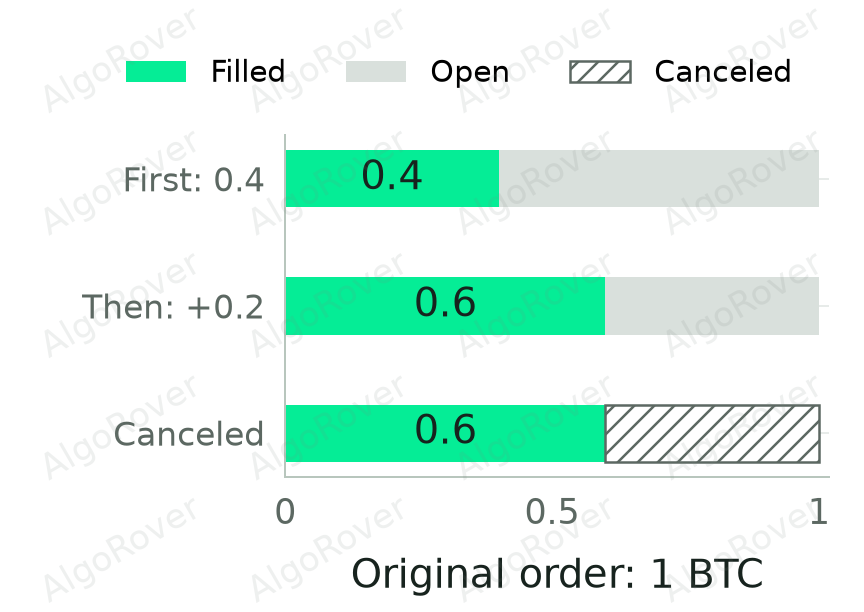
Check what has filled and what your account holds. The unfilled part may still execute. Suppose you have no BTC and place a spot order for 1 BTC, with no other orders or transfers. Leave fees deducted in BTC aside for now. The order could develop like this:
| Event | Cumulative fill | Open quantity | Check |
|---|---|---|---|
| First fill: 0.4 BTC | 0.4 BTC | 0.6 BTC | Position and protection size |
| Cancellation requested | Use confirmed records | Cancellation not yet confirmed | Any additional fills |
| Another 0.2 BTC fills | 0.6 BTC | 0.4 BTC | Average price and protection |
| Remaining 0.4 BTC cancellation confirmed | 0.6 BTC | 0 | Final account and order state |
Canceling an order does not reverse completed fills. It is like canceling the unshipped part of a delivery: what already arrived remains yours. A cancellation request and its final confirmation are separate events.
How should you size a stop after partial fills?
Check net holdings, available quantity and existing protection orders first, then apply the venue's rules. Owning 0.4 BTC does not make the intended 1 BTC available to sell. If cumulative fills rise to 0.6 BTC, reassess the covered quantity.
An oversized spot sell can be rejected or constrained by balance and other open orders. Derivatives also require checking position mode, direction and any reduce-only or close-on-trigger settings. Changing a quantity field alone does not prove that protection became active.
Track whether the old protection remains active, whether its replacement was accepted and whether new fills arrived during the change. “Request submitted” is not the same as a final order state.
How much should you reorder after canceling a partial fill?
Confirm the remainder's final state first, then calculate original target quantity minus final cumulative fills. Suppose the target was 1 BTC, final fills total 0.6 BTC and the remainder is canceled. You are 0.4 BTC short of the original target. Placing another full 1 BTC order could take total purchases to 1.6 BTC.
Bybit's cancel-order documentation also distinguishes acceptance of a cancellation request from the final order state. Check for late fills before deciding whether to buy more, and reassess the stop quantity against actual holdings.
How do GTC, IOC and FOK affect a remainder?
- GTC: the unfilled portion generally remains open until filled, canceled or otherwise terminated under venue rules.
- IOC: execute what is immediately available and cancel the remainder.
- FOK: fill the entire order immediately or cancel it.
Availability depends on market and order type. FOK can avoid an incomplete individual order by allowing no fill at all. It does not create liquidity.
How do partial fills change average entry and risk?
Suppose you buy 0.4 BTC at 60,000 USDT, then 0.2 BTC at 60,100 USDT. You spend 36,020 USDT for 0.6 BTC. Divide 36,020 by 0.6 and your average entry is about 60,033.33 USDT. The larger first fill carries more weight in that average.
At a reference stop price of 59,000 USDT, the price-gap risk is 36,020 − 0.6 × 59,000 = 620 USDT, before fees and any difference in the actual stop fill. Assess the position already held, then consider the exposure if the remaining order fills.
Existing holdings, sell fills or fees charged in the base asset change this simple purchase example. Reconcile the actual account rather than reusing its numbers.
Why can a backtest fill an order that live trading only partly fills?
A candle touching a price does not establish your queue position or sufficient opposing quantity. QuantConnect documents that its prebuilt backtest fill models assume complete fills, whereas live orders can fill partially; modeling partial fills requires an appropriate custom model.
Try checking what the program does when an order fills completely, fills partly or does not fill at all. Follow both the remainder and the exit. This is especially useful with narrow stops or fast entries: the position you planned and the one you actually hold can differ from the first trade.
Which records make a fill sequence explainable?
Retain order IDs, original quantity, time-in-force, individual fill quantities and prices, fees, change requests and final confirmations. Put events in order and establish the actual position before discussing another order.
If an order still has no fill report, continue with submitted versus filled orders. To estimate the funding and risk associated with a position first, use the spot position-size calculator.
Frequently asked questions
Does canceling the remainder undo completed fills?
No. Completed fills still establish holdings. Confirm the cancellation and inspect any fills that arrived before it completed.
Can I resend the original order size after a partial fill?
Reconcile cumulative fills and the original remainder first. Resending the full quantity can exceed the intended position.
Is a stop matching the filled quantity always sufficient?
Check existing positions, fee deductions, available balances, other protection orders and venue-specific direction and size rules.
Does a paper partial fill predict live fill rates?
Read the simulator's rules. Simulated events can test handling logic without reproducing real queue position, market impact or available quantity.
Check fills and open orders before ordering again
After a partial fill, ask the AI assistant in AlgoRover Live to inspect existing orders and positions. Establish how much filled and whether the remainder is still open before deciding whether to buy more or adjust a stop.
Sources
Not investment advice.