Crypto Backtest Survivorship Bias: Are You Using Today's Coin List?
Could you actually buy those coins back then? Check listings, delistings and ranking dates before crediting the trading rules for a good-looking backtest.

A three-year crypto backtest can look great if it only includes today's popular coins. What happened to the coins that were active then but later delisted? Were any included before they even launched? Survivorship bias often starts with that coin list. Check how it was chosen before deciding whether the returns came from the trading rules or from knowing which coins survived.
What goes wrong when you backtest today's crypto universe?
A historical trading universe should use information available at the decision time.Today's listed, liquid assets survived events that a trader at the historical start could not know. Excluding assets that later disappeared can create survivorship bias. Selecting past trades using future volume or market capitalization introduces look-ahead bias.
Those problems can coexist, but they need different checks. Recover missing candidates for survivorship bias; inspect the availability time of each selection input for look-ahead bias. A price series alone does not establish that an asset was eligible to trade.
Can a dynamic pairlist still use current market information?
Yes. “Dynamic” describes a changing list, not necessarily a historically correct one. Freqtrade's backtesting documentation warns that dynamic pairlists may depend on current market conditions and fail to reflect historical pairlist states. Lists other than StaticPairlist can also affect reproducibility. This is a warning about implementation, not a verdict on every dynamic universe.
First decide what you want to find out: how a few chosen coins performed in the past, or which coins your selection rule would actually have picked back then. These three approaches tell you different things.
| How you choose coins | What you find out | What is easy to miss |
|---|---|---|
| Pick today's popular coins and backtest their past prices | How your trading rules would have performed on those coins | Coins that were popular then but later delisted or lost liquidity may be missing, making returns look better |
| Choose only BTC and ETH and keep them throughout the test | How the same trading rules perform on BTC and ETH | The result covers those two coins; it does not show what a whole-market selection rule would have picked |
| Go back through history and choose coins each week using volume known at the time | Which coins you would have bought and how those trades would have performed | Use only data available then, and include coins that were tradable then but delisted later |
How do you build a point-in-time crypto universe?
- Declare the selection rule first. For example, rank eligible spot pairs at UTC midnight using the previous completed day's volume.
- Keep historical market membership. Include listing dates, suspensions, delistings and pair changes.
- Record data availability. Distinguish the period being measured from when its completed value could be retrieved.
- Save each rebalance. Record inclusions, exclusions and missing-data decisions, including how to exit a holding that leaves the list.
- Charge for the changes. Turnover, spreads and unfilled orders belong in the result.
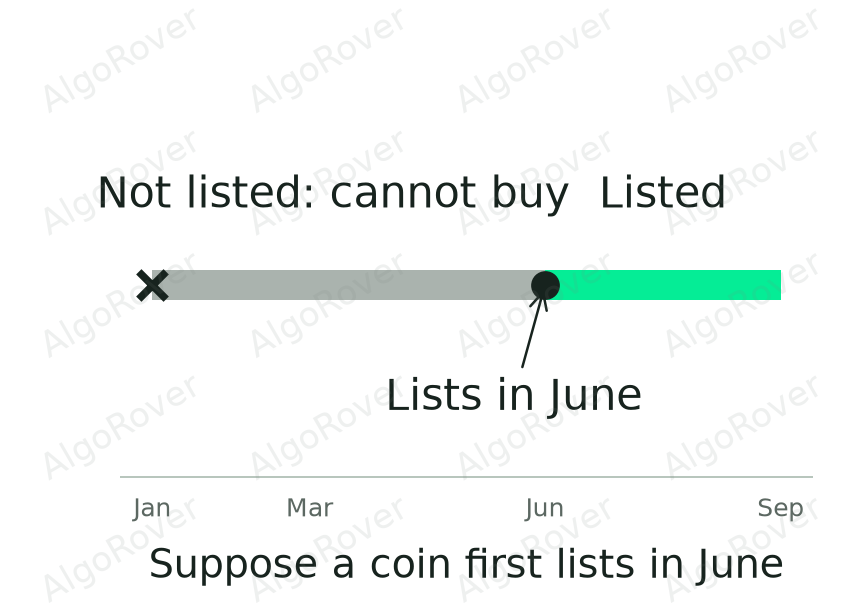
Suppose a coin launches in June, but your backtest buys it in January. That trade could never have happened. The same goes for using March's volume ranking to decide what to buy in February. Check those dates first to see whether later information slipped into earlier decisions.
Can you backtest without complete historical membership?
You can start with a fixed BTC and ETH basket to understand the trading rules. To answer what a whole-market selection rule would have earned back then, you need the listings, volume and replacement records available at the time. Saving today's list as a CSV makes it easier to rerun the same basket; it does not bring back missing coins.
You can study a declared fixed basket. That is useful for isolating entry and exit rules, provided the conclusion stays specific to that basket. Freezing the assets improves repeatability; it does not explain why those assets were chosen.
Where data permits, hold rules and dates constant and compare today's list with a reconstructed historical universe. Examine trade counts, turnover, membership changes and missing-data coverage alongside returns. Do not invent prices for delisted assets to make the dataset look complete.
What should you ask about a good-looking backtest?
Ask how the list was chosen, when it was settled, where the historical market information came from and how assets were replaced. Then pick a few dates and look back: which coins made the list, why were they chosen, and could you actually trade them then?
AlgoRover Research can help you understand strategy material and backtest results. Before running the rules, keep the strategy version, chosen coins and replacement conditions together so you can check that execution follows the same setup you reviewed.
Then look at out-of-sample validation and trading costs. Rebuild the list of coins available at the time, then see how much of the return your trading rules still produce.
Frequently asked questions
Does a fixed BTC and ETH backtest have survivorship bias?
Choosing them at a historical start because you now know they survived uses later information. It remains a valid fixed-basket study if you describe its scope accordingly.
Is yesterday's trading volume safe to use?
Check that the period had closed and its data was available before selection and trading. Historical listings and exit rules still matter.
Should missing delisted prices be replaced with zero?
No arbitrary replacement establishes a tradable exit. Investigate the last trading time and exit rules; identify any period that cannot be reconstructed.
Does StaticPairlist eliminate selection bias?
It helps reproduce the chosen assets. It does not establish that their selection was historically valid or that fills and costs were realistic.
Compare the coin list with actual trades
Once the historical universe is checked, run the selected strategy in a supported exchange Demo through AlgoRover Live. Inspect which coins it trades and when it replaces them, then compare orders and positions with your selection rules.
Sources
Not investment advice.