One losing trade, two P&L figures. Where did the difference come from?
Match the fills before comparing profit figures. In this OKX case, opening and closing fees explain most of a roughly 2 USDT difference between the exchange and workbench.
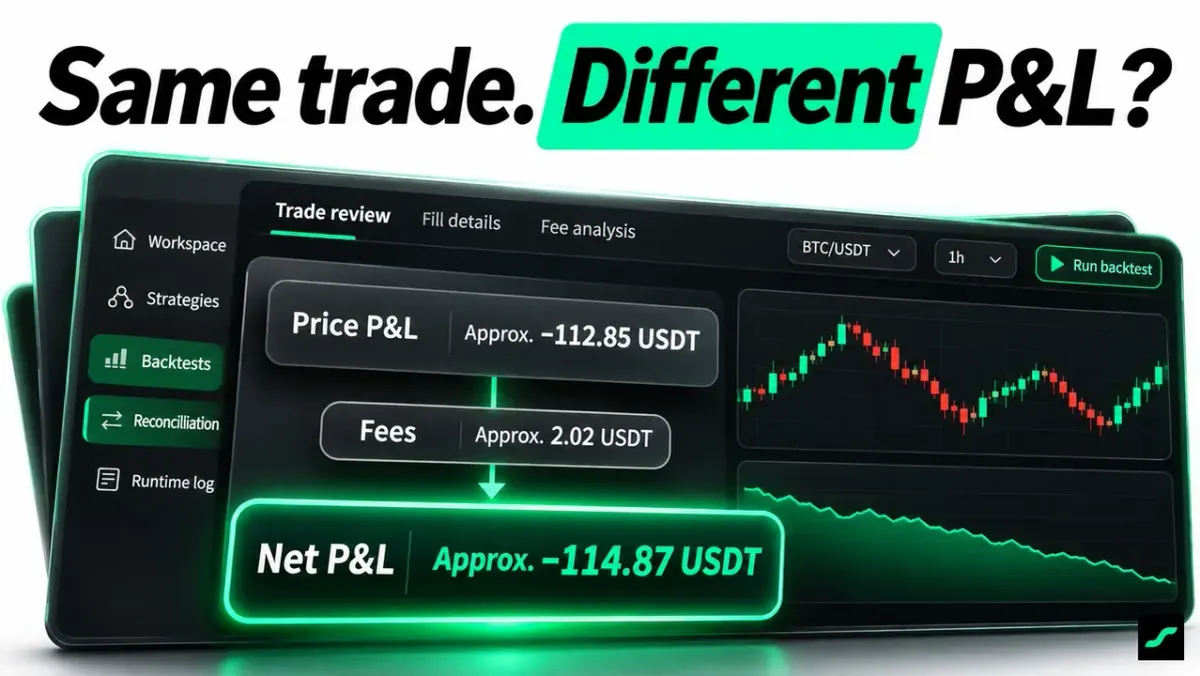
The same trade shows a loss of about 112.86 USDT on one screen and 114.87 USDT on another. Match the underlying fills first, then check whether each figure includes trading fees and funding. In this OKX case, two fee entries explain most of the roughly 2 USDT difference.
A trading bot, an exchange and a strategy workbench can use different definitions for realized P&L and net P&L. When comparing AlgoRover records with the exchange, match the contract, fill identifiers and reporting period before separating price P&L, costs and any remaining difference.
Which fills belong to each P&L figure?
OKX shows a loss of about 112.86 USDT. The workbench shows about 114.87 USDT. Why the difference?
Check that both figures cover the same contract and opening-to-closing cycle. Look for other fills, funding entries or a position that is only partly closed. Match records using the exchange's fill identifiers.
One order can generate several fills. Recalculate using each fill's actual price, quantity and contract unit, keeping the original precision.
How do opening and closing fees change net P&L?
The price calculation gives about −112.8504 USDT. What next?
Add the fees for opening and closing that position. In this case, the two charges total about 2.02308 USDT. Deducting them gives −112.8504 − 2.02308 = −114.87348 USDT.
That is close to the workbench's displayed −114.87 USDT. These fees explain most of the roughly 2 USDT difference.
| Item | Amount in this case |
|---|---|
| Price P&L from actual fills | About −112.8504 USDT |
| Combined trading fees | About 2.02308 USDT |
| After those fees | About −114.87348 USDT |
| Workbench display | About −114.87 USDT |

What if a small difference remains after reconciliation?
The exchange displays −112.86, but the calculation is −112.8504. Can I ignore the remaining amount?
Keep it as a separate unresolved difference. Its cause was not established in this source record. Check exported precision, transaction scope, contract conversion and aggregation rules.
A two-decimal display can affect comparisons, but you need the actual rule and complete records before attributing this specific difference to rounding.
So the main gap is explained, and the small residual stays on its own line?
Yes. Separating explained items from the residual lets you continue when another record becomes available.
Ask AI to reconcile fills, fees and funding
The resulting ledger can be compared line by line with the exchange statement. Keep the matching fill identifiers with any unresolved item.
Trading profit, fees and reconciliation: common questions
Does trading bot profit always include fees?
Read the page's definition. A figure may show price P&L alone or include opening fees, closing fees and funding. List the accounting items on both sides before comparing.
Can I compare realized P&L directly with net P&L?
Match completed fills and check each page's fee and funding treatment. Keep unrealized position P&L, realized price P&L and the result after costs separate.
Should I deduct slippage after using actual fill prices?
Slippage is the difference between expected and actual execution prices. Actual fill prices already reflect that price effect. Deducting an additional estimated slippage amount would count it twice; actual fees and funding remain separate entries.
What records do I need to reconcile OKX closed-position P&L?
Use the same contract and period, with fill IDs, actual prices, quantities, contract units, fees and fee currencies. Match those with the workbench records, preserve precision and keep any unresolved residual visible.