The US clocks changed. Does your strategy's trading window need to change too?
New York's 9:30 a.m. open maps to 9:30 p.m. in Beijing during daylight time and 10:30 p.m. during standard time. Whether to edit the strategy depends on its time-zone implementation.
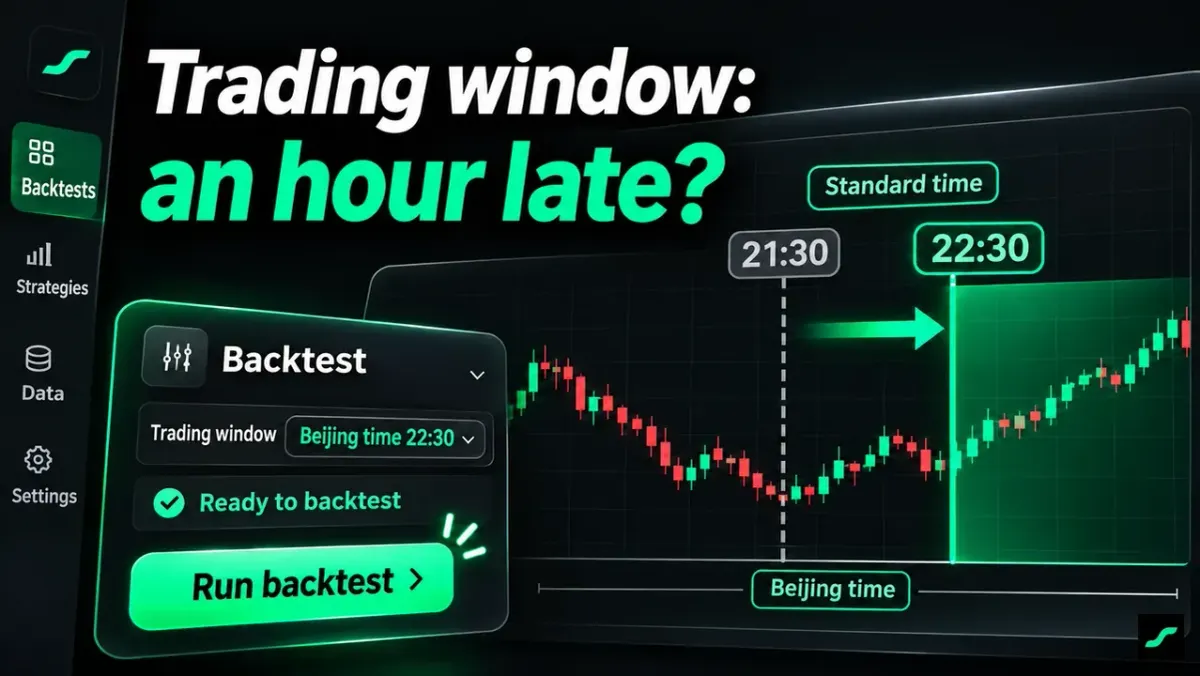
It's 9:30 p.m. in Beijing, but your strategy's US market-open window has not started. After US daylight saving time ends, New York's 9:30 a.m. open falls at 10:30 p.m. in Beijing. Whether you need to edit the strategy depends on how its trading window is defined: a named regional time zone or a fixed UTC offset.
A trading bot can involve market-local time, a strategy time zone, a server time zone and the interpretation of incoming timestamps. America/New_York has date-dependent rules. When reviewing an AlgoRover strategy revision, check the actual running instance and whether its candle timestamp marks the start or end of the bar.
What happens to the US stock-market open in Beijing time?
My strategy used to start checking at 9:30 p.m. Beijing time. Now it waits until 10:30 p.m. Did US daylight saving time end?
In 2026, US daylight saving time ended on November 1. New York moved from UTC−4 to UTC−5. Beijing stays on UTC+8, so the same New York clock time maps to one hour later in Beijing.
Regular US stock trading starts at 9:30 a.m. Eastern Time. That is 9:30 p.m. in Beijing during daylight time and 10:30 p.m. during standard time.
| New York time standard | Local open | Beijing equivalent |
|---|---|---|
| Daylight time: UTC−4 | 09:30 | 21:30 |
| Standard time: UTC−5 | 09:30 | 22:30 |
Should you add an hour to every time parameter?
Can I just add one hour to the strategy's time settings?
Inspect the implementation first. Correct conversion using America/New_York applies the date's daylight-saving rules. Adding another hour manually could move a correct window away from its target.
A hard-coded Beijing time of 21:30 or a permanent UTC−4 conversion needs review if the intended target is New York's 9:30 a.m. open. List both the configured value and the converted result before editing.
So I need to inspect how the code represents time, as well as the clock on the screen?
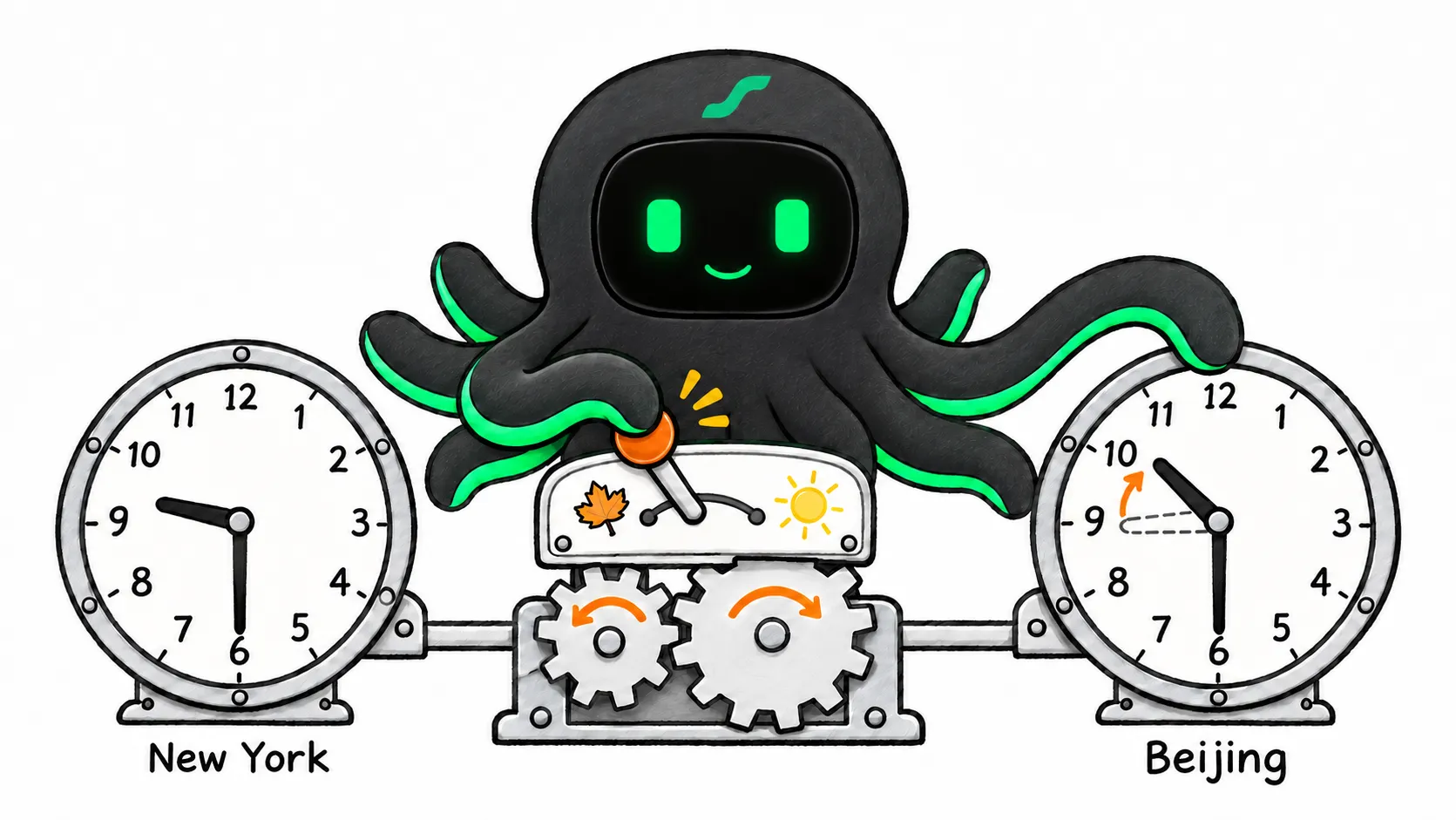
Yes. Named time zones, fixed offsets, server time and incoming timestamps participate at different stages of the calculation.
How do candle timestamps line up with the entry window?
The server clock is right and data keeps updating. What else should I check?
Take one real market-data record. Show its raw timestamp, UTC interpretation, New York time and Beijing time alongside the day's window start and end.
Check whether the candle timestamp marks its opening or closing time, and whether the strategy evaluates after bar close or on live updates. This separates time-zone conversion from signal timing.
Even with the correct window, a trade might not happen at the open?
Once the window opens, the strategy still evaluates its entry conditions. Continue from the signal to order submission and the execution result.
Ask AI for a before-and-after daylight-saving schedule
The comparison shows whether the window stays anchored to the same market-local time. If an edit is needed, save a new revision and verify that the running instance uses it.
Trading time zones and daylight saving: common questions
Does every trading strategy need a one-hour change after daylight saving ends?
Check the target and implementation. A correctly implemented regional time zone converts by date. A rule anchored to a fixed local time follows that definition; a hard-coded offset needs review against its intended market time.
How do exchange, strategy and server time zones differ?
Exchange time describes the market-local clock. Strategy time controls time-based rules. Server time affects system displays and local-time functions. Convert the same record to UTC, then compare each interpretation.
Why are there no trades after the trading window opens?
The window permits evaluation. Entry conditions, warm-up, cooldown, positions and order status still affect execution. Check fresh data, then the signal, submission and fill records.
Why can backtest and live trigger times differ?
Compare date-specific time-zone conversion, candle start versus end timestamps, and bar-close evaluation. Then inspect live data arrival and order response times, plus the revision used by the live instance.