AI Trading Bot Token Costs: Which Decisions Can Run as Rules?
A short answer can still carry a long input. See how model calls add up and where strategy reuse and fixed-rule execution can reduce token usage.

Where do an AI trading bot's tokens go? One market assessment can involve several model requests: reading data, producing a judgment and analyzing tool results. Even if the final answer is just “hold,” the rules, market data and conversation history sent along the way count toward input usage. To control costs, first identify when the model is called and how much context each request carries. Then decide which calls are worth keeping.
Why do AI trading bots consume so many tokens?
The useful distinction is between asking a model to decide on every cycle and using AI to research a strategy whose defined rules then run in software. These workflows make different numbers of model requests. To calculate token costs, check how many requests are made, how much content each sends, how long the model's responses are and the model's token prices.
In the first design, new market data, positions or news enter a model workflow that produces an assessment or proposed action. Analyst roles, tools and reviews can make one decision involve several requests. Those calls can be useful when the task needs interpretation of text or complex evidence.
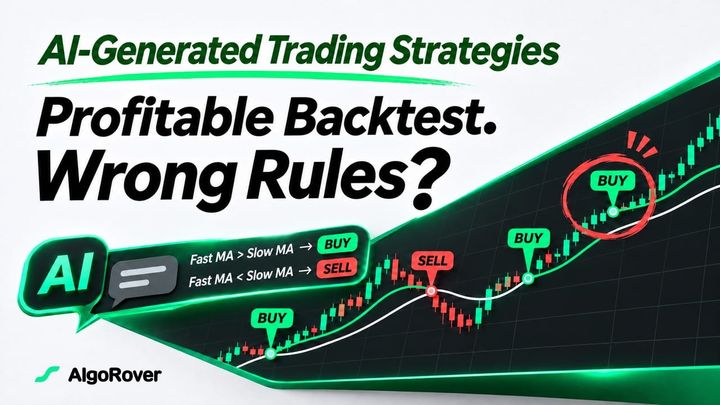
In the second design, explicit conditions stay in the strategy program. For example: generate an entry signal when the fast moving average crosses above the slow one on a closed candle, with no additional entry while a position is open. When software computes the indicators and conditions, it need not repeatedly submit the context to a model.
It is like agreeing on a shift checklist: run it on schedule and discuss changes when needed. You do not need a new meeting for every routine check. The avoidable calls are the ones spent reinterpreting conditions that have already been settled.
Where can AlgoRover's approach reduce token usage?
With AlgoRover Research, you can use AI to find published strategies, select available presets and markets, preview a configuration, and review trades and reports after completion. AI is useful for understanding the strategy, defining a test and interpreting results.
AlgoRover's library contains 4,000+ strategies, including strategies uploaded and shared by experienced traders. Users can select a strategy and install it with one click. Through AI conversations, users can adapt existing strategies, adjusting trading rules and parameters to suit their trading goals and risk preferences.
Starting with an existing strategy and focusing on the parts you want to change can reduce the input and output tokens spent describing a strategy from scratch, generating a complete set of rules and repeatedly explaining the same requirements.
For example, if a moving-average strategy is close to what you need, ask AI to explain its existing rules first. Then discuss changes around your position requirements and parameter settings. Keep the parts that fit and focus the conversation on what needs to change, carrying that work into subsequent research.
For execution, we pass the selected strategy program and parameters to an engine: Research runs a historical backtest, while Live passes the strategy to the trading engine on your runtime device. When a fixed-rule strategy computes its indicators and signals in code, routine checks can run there without model requests increasing with every candle.
| Task | Model judgment each cycle | AI research plus fixed-rule execution |
|---|---|---|
| Routine market check | Submit data and conditions for another model judgment | Update indicators and evaluate conditions in code |
| Rules and historical context | May be resent with each request | Keep rules and parameters in the strategy configuration; routine calculations need not explain them to a model again |
| New hypotheses and changes | Call models according to the decision and research workflow | Use AI around a research question, then review configuration changes |
| Anomalies and review | Depends on the review workflow | Provide relevant records when AI analysis is needed |
Savings can occur at two stages: during research, reuse an existing strategy to reduce generation from scratch and repeated explanations; during execution, let code check fixed conditions to reduce routine model requests and their repeated context. Research, changes and interpretation can be organized around actual questions.
This benefit applies to explicit conditions expressible in code. If the strategy needs a model to interpret each news event or announcement, retain a budget for those necessary calls.
What does a five-minute model loop cost over 30 days?
Monthly AI trading bot token cost = monthly input tokens / 1,000,000 × price per million input tokens + monthly output tokens / 1,000,000 × price per million output tokens. Calculate cached inputs and other applicable billing categories separately using the provider's bill. Measure usage first, then apply the prices of the model you use.
Consider an illustrative budget: 30 uninterrupted days with one check every five minutes, or 8,640 checks. Workflow A requests one model judgment per check. Workflow B checks routine conditions in code and separately budgets 120 requests for research, changes and review. That allowance is an example assumption, not an AlgoRover quota or measured monthly average.
To isolate request count, give each request in both workflows 2,000 uncached input tokens and 300 output tokens. Use teaching prices of $1 per million input tokens and $4 per million output tokens. Exclude caching, retries, additional reasoning and tool charges from both. These are not current prices for a named model.
| Workflow | Model requests | Input / output tokens | Model cost |
|---|---|---|---|
| A: one model request every five minutes | 8,640 | 17.28 million / 2.592 million | About $27.65 |
| B: code checks conditions; separate research allowance | 120 | 240,000 / 36,000 | About $0.38 |
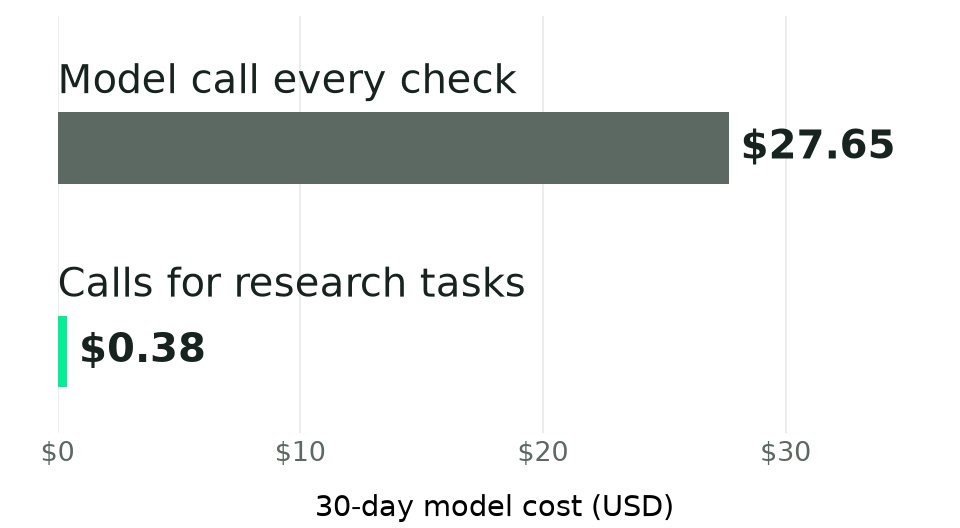
Each example request costs 2,000 / 1,000,000 × $1 + 300 / 1,000,000 × $4 = $0.0032. A costs $27.648 and B costs $0.384, a difference of $27.264. The table rounds to two decimal places.
The saving has a specific cause: B does not request a model judgment for each of its 8,640 fixed-condition checks. It still processes market data and uses research conversations. Actual research requests may be longer; automated AI reviews, event analysis and retries must also enter B's bill.
Does reducing model calls mean missing signals?
Separate checking the market less often from requesting a model less often. A five-minute rule can still be evaluated every five minutes by software. Saving tokens on a mathematical condition does not require turning it into an hourly check.
Keep calls where information needs interpretation. If the strategy requires understanding an announcement, deleting that step changes the strategy. A news-analysis workflow and a moving-average rule answer different questions; a lower bill alone does not establish which fits better.
How can you identify avoidable token usage?
- Find the triggers. Does every candle call the model, or do calls occur during research, event analysis and review?
- Count the full request chain. Include tool follow-ups, additional judgments and retries.
- Inspect repeated inputs. How much of the same rules, history and market data is resent?
- Identify fixed conditions. Could software evaluate them, with its behavior checked against the specification?
- Price actual usage. Apply the relevant input, caching, output and other categories from provider records.
A short answer can carry a long context or billable reasoning. Caching can reduce some repeated-input charges; evaluating a fixed condition directly in code can avoid the request for that check. Account for these savings separately.
Give AI a defined research task
Find a published strategy in Research that is close to your needs and understand its entry, exit and sizing rules. Tell AI what to keep and what you want to adjust, then select available parameters, presets and markets and preview the backtest configuration. Test the changes, review the report and refine the strategy using what you have already learned.
Find several published BTC strategies. Explain their entry, exit and position-sizing rules and list available versions, parameters, presets and markets. I want fewer frequent entries. Choose a strategy close to that goal, explain which rules to keep and which settings to test, and list any requirements you need me to clarify. Preview a backtest configuration without starting a run.
Get started with AlgoRover Research. When you need ongoing execution, review Live's Demo and deployment settings. Hosting, market-data services and trading fees belong in the total operating budget alongside model usage.
Let software keep checking defined rules. Use AI for questions worth thinking through again. Then the token savings have an explanation you can trace.
Frequently asked questions
How can reusing an existing strategy save tokens?
An existing strategy gives you a starting point for entry, exit and position-sizing rules. Choosing one close to your needs and focusing AI conversations on the changes can reduce the tokens spent describing requirements and generating complete rules from scratch. Savings depend on the scope of changes, number of requests and actual input and output lengths.
Does AlgoRover call a language model on every candle?
We pass strategy programs and parameters to an engine. A fixed-rule strategy that computes indicators and signals in code does not need a fresh model request for every candle. Research conversations, interpretation and additional model-driven tasks have their own usage.
How can an AI trading bot reduce input tokens?
Identify requests that only repeat fixed-condition checks. Moving those conditions into code can eliminate those requests together with their market data, rule descriptions and conversation context. Optimize input scope and caching separately for research and analysis that still need a model.
Does executing without a model request mean zero running cost?
Compute, machines or hosting, and potentially data and trading fees remain. This article compares model-token costs, not the entire operating bill.
Does a monthly AI subscription make request counts irrelevant?
Check its allowances, limits and permitted usage. Subscription and metered API billing differ; repeated requests can still consume allowances and add latency.
Sources
- TradingAgents: a research framework with LLM analyst and decision roles
- OpenAI: tokens and usage
- OpenAI: prompt caching and billing
For research and education; not investment advice.