API Key Permissions for Trading Bots: Research, Demo and Live
Reading prices, inspecting an account and placing orders need different access. Match the key to the task before switching from research or demo to live trading.
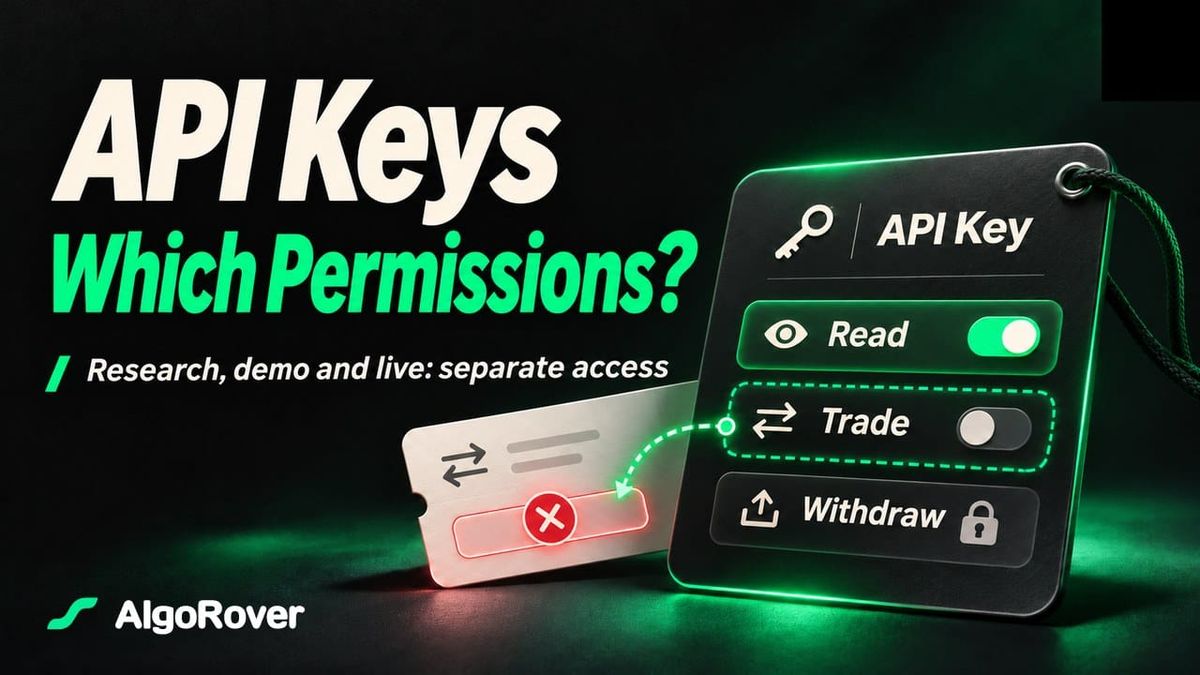
You want an AI assistant to review a strategy, but the setup asks for your exchange API key. What access does it actually need? Public market research and historical backtesting generally need no trading permission. Reading your private account, placing orders and canceling them need their own authorization. Separate those tasks before choosing a key or switching from demo to live trading.
Do you need an exchange API key for research and backtesting?
An API key is a credential a program uses to access an exchange. Its permissions determine what the program can do. Viewing public prices, reading your account and placing an order are separate jobs.
Binance, for example, labels public market-data endpoints NONE, private account and order information USER_DATA, and order placement and cancellation TRADE. Each endpoint has its own authorization requirements. Binance permission definitions
| Task | Typical requirement | Check first |
|---|---|---|
| Public strategies and prices | A public endpoint; some data services require a login or data credential | Data source |
| Historical backtesting | Historical data and strategy configuration | Data-source authorization |
| Local simulated execution | Simulation configuration; some feeds require read-only credentials | Orders remain simulated locally |
| Exchange demo trading | Credentials for the test environment | Key, endpoint and run mode match |
| Live trading | Necessary account-query and trading permissions | Market, account and order scope |
The label “paper trading” does not settle the credential question. Find out whether orders are simulated locally or sent to an exchange test environment. The latter usually needs dedicated test credentials.
What is the difference between read, trade and withdrawal permissions?
Think of the key as an access badge. The records room, trading desk and funds exit have separate doors. Opening every door just to check a balance makes it harder to explain what the program actually needs.
| Permission | Common use | Configuration principle |
|---|---|---|
| Read | Balances, positions, orders and history | Check whether read-only access is sufficient for reporting or monitoring |
| Trade | Place and cancel orders; exact scope varies by exchange | Enable only the spot, futures or other functions the task requires |
| Withdraw and transfer | Withdraw funds or move them between accounts | Ordinary order placement needs no withdrawal access; examine transfer scope separately |
Reading and trading can also use separate keys. Binance's documentation gives that example: one key trades while another queries order status. Check whether your tool supports that configuration.
Read the details behind the permission name. On OKX, Trade includes funding transfers and certain account settings as well as placing and canceling orders. A key without withdrawal permission can therefore have powers beyond buying and selling. OKX API permission definitions
Should demo and live trading use different API keys?
Demo credentials belong to a test account; live credentials reach real funds. Check three things together when switching: the key's environment, the API endpoint and the program's run mode.
OKX Demo Trading, for example, uses a key created in the demo environment and the corresponding simulated-trading request flag. Mixing a live key with demo mode can cause connection failures even when the key has broad permissions. OKX demo API FAQ
If demo works but live orders fail, continue with the account and order checks for the demo-to-live transition.
Where should you store API keys on a computer or VPS?
Use the tool's documented local credential configuration on the device that actually runs the program. When moving to your own VPS, check its credential setup and network egress address. An exchange IP allowlist must permit the address sending the requests.
The computer displaying your chat is not necessarily the machine trading. If the program runs on a server, the exchange receives the server's requests. Binance recommends appropriate IP restrictions for access beyond reading. Binance API key guide
Keep complete secrets in the local credential configuration. For troubleshooting, share permission names, run mode and a redacted error message.
When does AlgoRover need exchange credentials?
AlgoRover Research can discover public strategies and use supported public market data for historical research without connecting an exchange account. A product login and an exchange API key serve different purposes.
When moving to AlgoRover Live, check credentials for the selected local simulation, exchange Demo or live mode. Live manages trading credentials locally by mode, while funds remain in your exchange account. Starting live trading requires your explicit confirmation of configuration and permissions.
Write down what this task needs to read, change and run on. Then consult the AlgoRover Live guide. For strategy research, start with AlgoRover Research.
Common questions
Can AI analyze my trade history without trading permission?
You can provide redacted fills, positions and cost records for an AI assistant to explain. A tool that reads your private exchange account directly needs the appropriate read access. Decide separately whether it should also be allowed to place orders.
Can a bot still lose money when withdrawals are disabled?
Yes. Trading permission still allows orders, and the wrong direction, size or frequency can create losses. Disabling withdrawals restricts a funds exit; strategy rules and position limits still need their own checks.
Should I enable every permission to fix an API permission error?
First check the endpoint, spot or futures market, account mode, demo or live environment, and IP allowlist. Change the specific missing permission once you identify it.
Is removing a leaked key from the bot enough?
Revoke the key at the exchange, then review account activity and outstanding orders. Deleting local configuration does not invalidate the exchange-issued credential.